
How to Search Civil Dockets
Mobile County Circuit and District civil case details are available through Just One Look for paid on-demand access and Alacourt.com for subscribers. AlaFile handles filing and service rather than anonymous public search. Before opening either record product, identify the division. Common prefixes are CV for Circuit Civil, DC for District Civil, SM for Small Claims, and DR for Domestic Relations.
A full case number gives the cleanest match. A party-name search should be checked against Mobile County, case style, court, filing date, and status. The event list is an index, not always the document itself. If an image cannot be opened, the Circuit Clerk division can explain inspection and copy options. Probate records use the separate Mobile County Probate Court.
- Determine whether the matter is CV, DC, SM, DR, or probate.
- Search by the exact case number or sufficiently specific party name.
- Match the county, court, case style, parties, judge, and filing date.
- Read service, response, motion, order, setting, and judgment entries in sequence.
- Check the newest setting or order rather than an older date left in history.
- Call, visit, or request a copy from the division that keeps the file.
Mobile County Civil Docket Paths
Mobile County civil dockets do not sit in one undivided queue. Circuit Civil handles general-jurisdiction civil matters. District Civil and Small Claims handle their assigned limited-jurisdiction matters. Domestic Relations has its own clerk counter and privacy concerns. Probate matters, including estates, guardianships, conservatorships, and adoptions, are held by the separate Probate Court clerk.
| Prefix or court | Record path | Custodian |
|---|---|---|
| CV | Circuit Civil case-details record | Mobile County Circuit Clerk, Circuit Civil |
| DC | District Civil case-details record | Mobile County Circuit Clerk, District Civil |
| SM | Small Claims chronology | Mobile County Circuit Clerk, Small Claims |
| DR | Domestic Relations docket | Mobile County Circuit Clerk, Domestic Relations |
| Probate | Separate statutory probate docket | Mobile County Probate Court |
The prefix should be confirmed against the displayed division. Codes can have system-specific meanings, and the court type controls which office can supply the record.
Mobile County Civil Service Returns
Service comes before the response deadline and trial setting in a Small Claims chronology. Look for summons issuance and the sheriff or certified-mail return.
The clerk mails a printout of the service date. The official Small Claims instructions say the office does not check that service by phone.
What a Civil Docket Shows
A Mobile County civil docket begins with the number, court, judge, filing date, status, and case style. Party roles may be plaintiff and defendant or petitioner and respondent. Counsel should be matched to the side represented. The chronological section then tracks the complaint or petition, summons, service return, answer, motions, orders, settings, resolution, judgment, enforcement, and appeal.
| Header | CV, DC, SM, or DR number, Mobile County division, filing date, judge, and status. |
|---|---|
| Parties | Plaintiff and defendant, or petitioner and respondent, with counsel roles where shown. |
| Service | Summons or citation issuance, delivery method, and return. |
| Filings | Complaint, petition, answer, counterclaim, motion, and signed order events. |
| Settings | Conference, motion hearing, bench or jury trial, and later reset entries. |
| Outcome | Dismissal, nonsuit, default, merits judgment, costs, and appeal activity. |
Financial blocks may combine filing costs, judgment amounts, and enforcement figures. Labels and dates must be read before treating any number as a current balance.
Mobile County Civil Small Claims Timing
The official Small Claims FAQ gives a useful Mobile County docket sequence. Filing assigns the case number. Service then proceeds through the sheriff or certified mail. After service, the defendant has 14 days to answer. When an answer is received, the office says a trial is generally set six to eight weeks later. A conflict requires a motion to continue rather than an informal assumption that the date moved.
The official Small Claims source is included below to show that process.
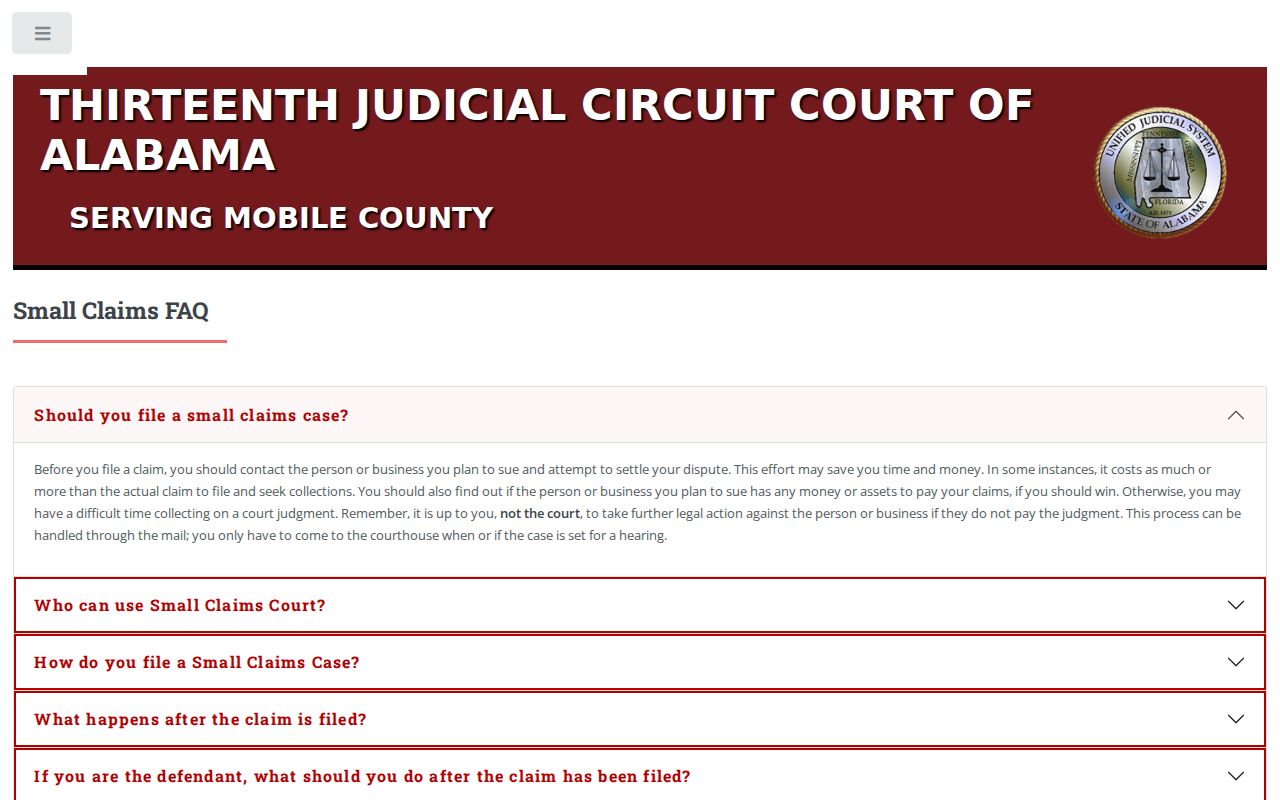
The clerk mails a computer printout showing the service date and states that it does not check service by phone. That local rule makes the return-of-service entry a key step before any answer deadline or trial setting is read.
Mobile County Civil Trial Date Checks
An old trial date is not proof of a current setting. Search forward for a motion to continue, signed order, reset, or new notice.
Confirm the live date with Circuit Civil, District Civil and Small Claims, or Domestic Relations according to the displayed case prefix.
Types of Civil Cases on the Docket
The requested relief and case category determine the Mobile County civil docket. Circuit and District divisions handle different civil authority. Small Claims provides a streamlined path within District Court. Domestic Relations uses petition-based roles and includes distinct privacy rules. Probate remains outside the Circuit Clerk's ordinary civil file even though it is a civil court function within Mobile County.
- Circuit Civil complaints, motions, orders, trials, judgments, and appeals.
- District Civil matters assigned to the limited-jurisdiction state court.
- Small Claims filings, service, answers, trials, and judgments.
- Domestic Relations petitions, temporary orders, hearings, and final orders where public.
- Probate estates, guardianships, conservatorships, adoptions, and other statutory matters.
The District Civil and Small Claims page documents the shared local counter.
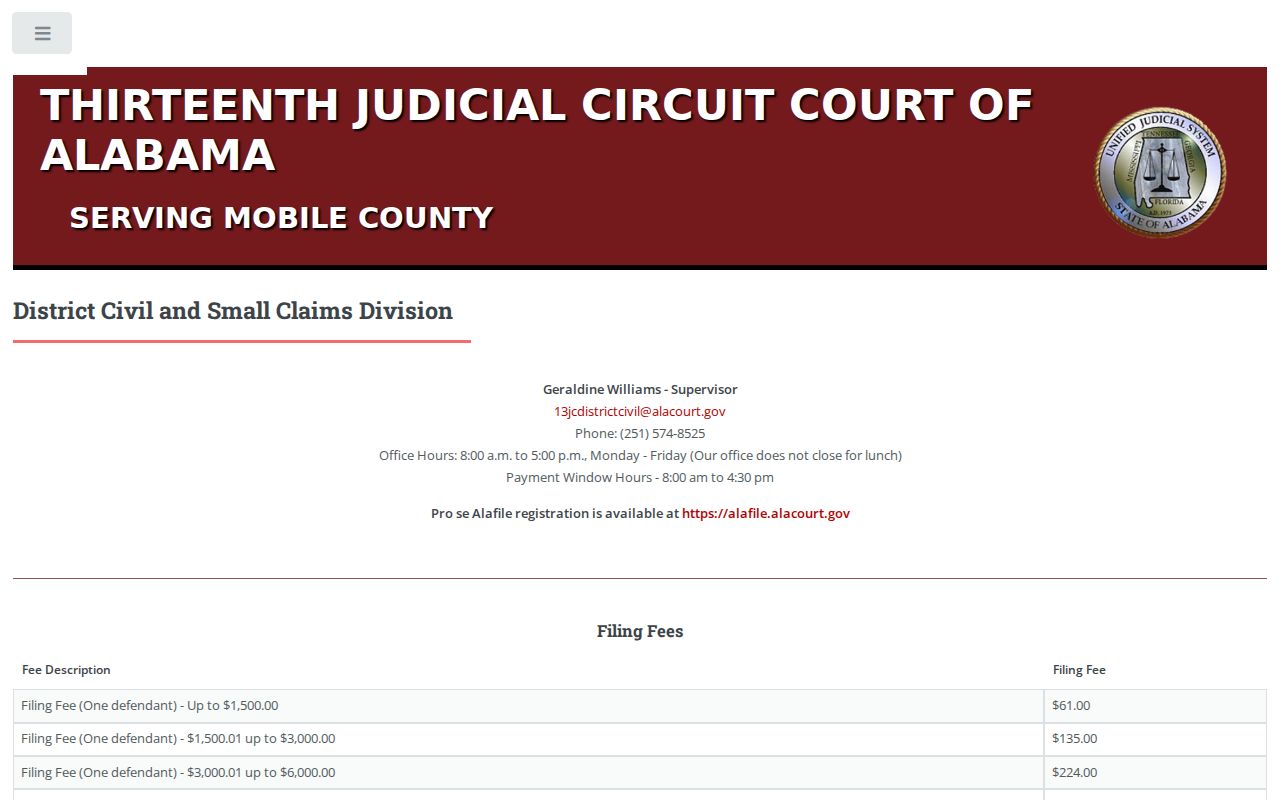
This division page is the right fallback when a DC or SM search needs a setting check, current form, or clerk procedure.
Mobile County Civil Motion Order Pairs
A motion entry only proves that a party asked the court to act. It is not the ruling. Search forward for a signed order tied to that request. The order may grant, deny, partly grant, set a hearing, or reserve the issue. The same caution applies to a trial date. An old setting stays in the record after a continuance, so the latest order and notice control.
Outcome terms also differ. A default judgment follows a failure to respond or defend as required. A nonsuit or voluntary dismissal ends the claimant's case subject to the governing rule. DWOP means dismissal for want of prosecution or failure to proceed. A merits judgment decides the claim. Post-judgment entries can add garnishment, execution, other enforcement, a post-judgment motion, or a notice of appeal.
Settings and Hearings on Civil Dockets
The newest notice or signed scheduling order is the first source for a Mobile County civil setting. Case details in Just One Look or Alacourt can show hearing and trial events, but old dates remain in the chronology after a reset. The Circuit Clerk prepares notices, while the assigned judge controls the setting. Match the event type, date, judge, courtroom, and any later continuance.
Circuit Civil can be reached at 251-574-8420. District Civil and Small Claims uses Room 317 and 251-574-8525. Domestic Relations uses Room C-909 and 251-574-8441. Counter inspection during regular hours is an option when remote detail is thin. A current hearing date may also be checked through the Mobile County court calendar process before travel.
Note: A reset changes the live date but leaves the prior Mobile County civil docket event visible as part of the case history.
Mobile County Civil Domestic Dockets
Domestic Relations is part of the Mobile County Circuit Clerk structure but uses its own office and forms. Its courtrooms are on the second floor of Government Plaza, while the clerk counter is Room C-909. Revised pretrial orders posted in October 2024 require current mailing and email information. The divorce order also calls for proposed trial exhibits to be uploaded at least three business days before trial, subject to stated exceptions.
The official Domestic Relations page is the local source for current instructions.
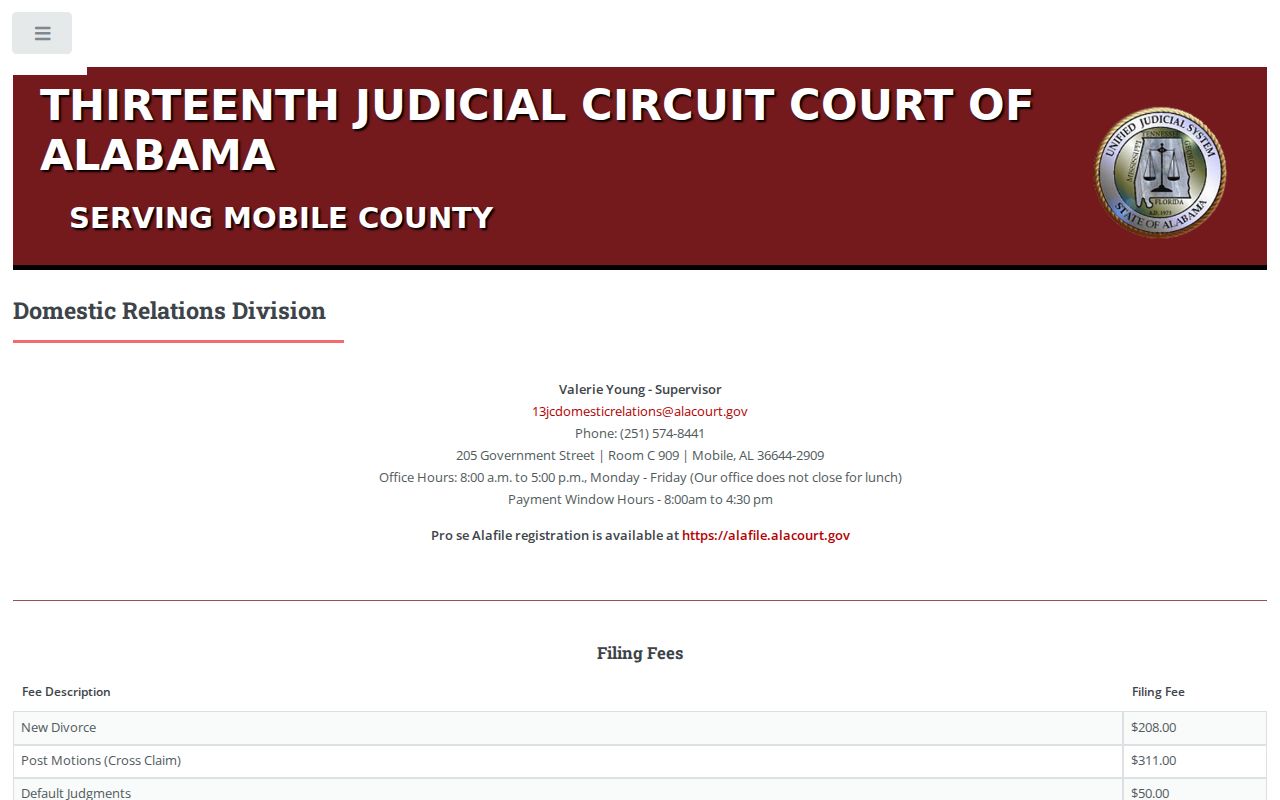
Public access depends on the record. Family filings can contain protected data, and a portal result may omit confidential details or images even when a case exists in the clerk's system.
Mobile County Civil Probate Boundary
Probate is a separate docket owner. Estate, guardianship, conservatorship, adoption, and other statutory probate records do not move into the Circuit Civil portal route by default.
Use the Mobile County Probate Court clerk for those files. The Circuit Clerk's civil divisions cannot replace that custodian.
Public Access to Civil Dockets
Alabama's Court-Record Privacy and Confidentiality Rules apply to Mobile County Circuit, District, Small Claims, Municipal, Probate, and other covered courts. Permitted electronic dockets and filed records in District and Circuit actions may be viewed without charge at the clerk's office during regular hours. Remote subscriber or on-demand products may charge for access, and the clerk may charge for copies and requester-paid postage.
Key rules:
Alabama Court-Record Privacy and Confidentiality Rules govern viewing, sealing, and restricted data.
Alabama Rule of Civil Procedure 5.1 requires filers to protect listed personal identifiers.
Alabama Rule of Judicial Administration 30 governs public and bulk court-record access.
Adoptions, juvenile matters, some mental-health or protective proceedings, and records sealed by order may not be publicly displayed. A failed public search proves only that the interface returned no public result. Contact the owning Mobile County clerk and ask what ID, party status, authorization, or court order is required.
Mobile County Civil Circuit Counter
Circuit Civil provides a direct local route when portal detail is not enough. The division handles its own filings, record questions, and setting confirmation through 251-574-8420. Most current court records are electronically imaged, yet that fact does not make every image free or public. A docket event can exist without a viewable document.
The Circuit Civil office page is the official source captured below.
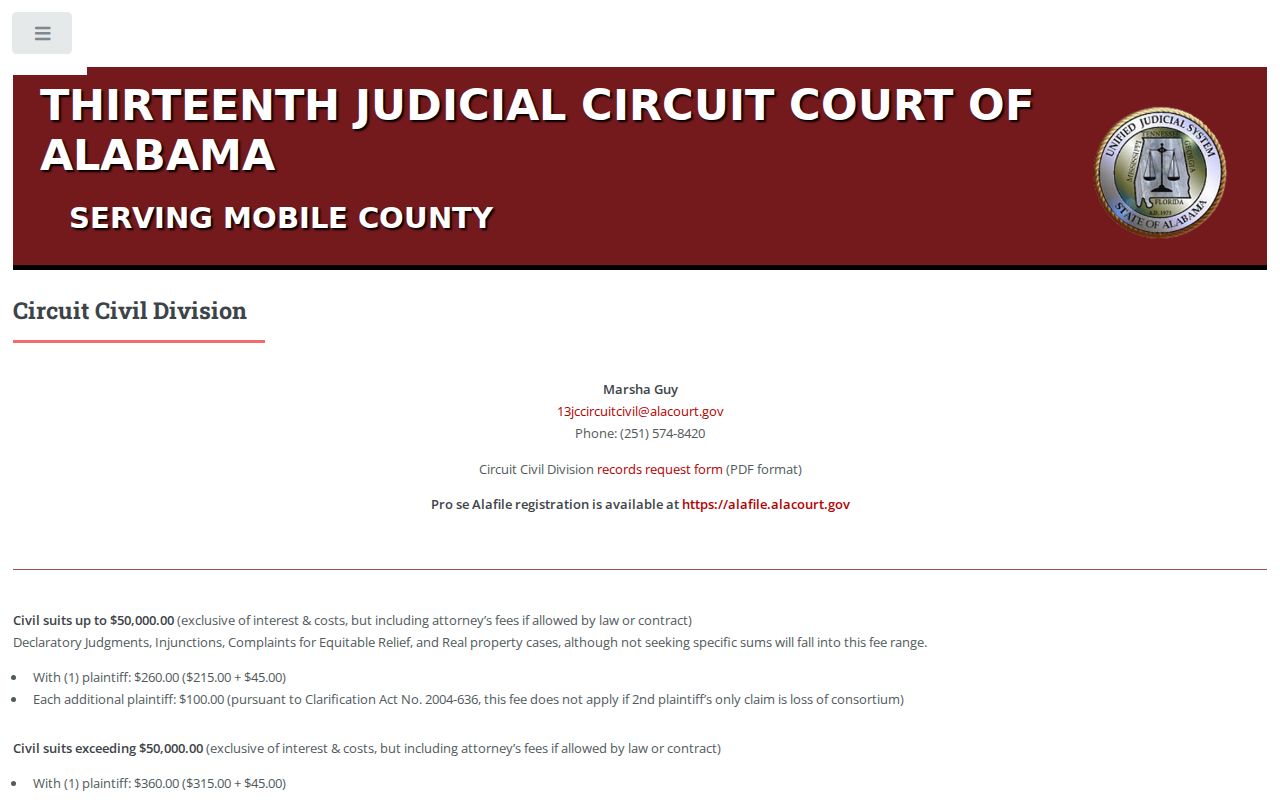
Ask the clerk for the exact event or signed order needed. A portal image is an access copy, while a certified judgment is authenticated by the clerk for a process that requires official proof.