
How to Search Criminal Dockets
State Circuit and District criminal cases are available through Alabama's official paid record products. Just One Look provides on-demand public access, while Alacourt.com serves subscribers. Neither is the same as AlaFile, which is built for filing and electronic service. Start with the court shown on a notice, warrant, citation, or prior order. A CC prefix points toward Circuit Criminal, while DC and TR identify District-level paths. A city citation stays with the issuing municipal court.
The strongest query uses the full case identifier. A name search can help when the number is unknown, but county, division, case style, and filing year must all match before the event history is used. Remote access is only one route. The Mobile County Circuit Clerk also provides division phone help, counter inspection during clerk hours, copies at the courthouse, and a mailed request for Circuit Criminal material.
- Identify Mobile County and the state or municipal court named on the record.
- Use the complete CC, DC, or TR case number when it is available.
- Confirm the style, division, judge, filing date, and status on the matching result.
- Read the newest setting, order, charge entry, and disposition for each count.
- Call or visit the owning clerk division when an event or image is missing.
- Request a plain or certified copy when the docket index alone is not enough.
Mobile County Criminal CC Search
A felony can leave entries in two Mobile County criminal dockets. Complaint, bond, preliminary-hearing, or transfer activity may first appear in District Court. An indictment then advances the prosecution in Circuit Court under a CC number. The records are related, but they are not one merged file. Searchers should retain both identifiers and compare the dates linking the District and Circuit stages.
The Circuit Criminal division page shows the clerk channel for felony records. Its captured source view appears below.
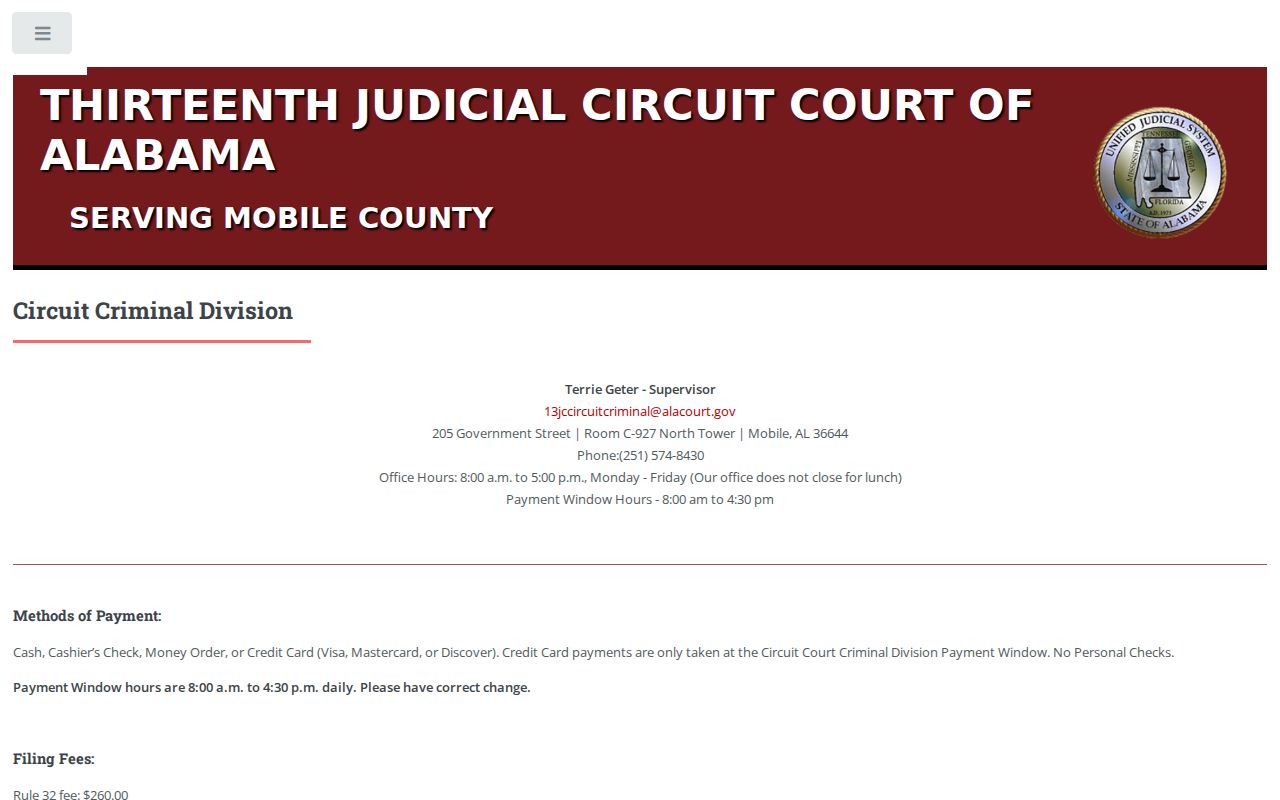
The division-specific route matters because Circuit Criminal keeps the later felony docket, related filings, and copy requests rather than every criminal matter arising in Mobile County.
Mobile County Criminal Appearance Times
District Court lists state traffic at 8:00 a.m. and criminal appearances at 8:30 a.m. These are separate calendar lines even though both use the fourth floor.
Read the notice for the exact case. A felony CC setting may be assigned to a Circuit courtroom on floor six or eight instead.
What a Criminal Docket Shows
A Mobile County criminal docket begins with identifying fields and then records events in date order. The header should show county, court division, case number, filing date, assigned judge, style, and status. Charge rows may be amended or resolved in different ways. Read each count on its own. Bond data describes release security or conditions, not the final result. Financial entries can include fines, costs, restitution, and payments, but visibility varies by case type.
| Case number | A CC, DC, or TR identifier tied to Mobile County, year, division, and sequence. |
|---|---|
| Charges | Offense description, count, and classification or statute when entered. |
| Events | Complaint, warrant, indictment, motion, order, plea, trial, sentence, and appeal activity. |
| Settings | Date, time, type, and court information, followed by any reset or continuance. |
| Disposition | Outcome for a count, such as guilty, dismissed, nol pros, or acquitted. |
| Images | Links to permitted documents; sealed or confidential images remain withheld. |
A case-level label such as “disposed” does not explain every charge. Match each result to its date and count, then read sentencing or appeal entries that follow.
Mobile County Criminal Docket Terms
Small wording differences can change the meaning of a Mobile County criminal record. The chronological docket should be read with the charge rows and signed orders, not reduced to one status label.
- Nol pros
- The prosecutor's formal decision not to proceed at that time.
- Dismissed
- A charge or case ended without the requested adjudication; the date and count still matter.
- Acquitted
- A not-guilty result after the issue was decided.
- Disposition
- The system summary of how a count or case concluded.
- Bond forfeiture
- An event concerning bond security, not a conviction or acquittal.
Restricted youthful-offender treatment and diversion entries may not display like an ordinary public disposition. The owning clerk can state the access process without disclosing protected facts.
Mobile County Criminal Bond Status
Bond entries describe release security, conditions, forfeiture, or revocation. They do not state whether a charge ended in conviction, dismissal, nol pros, or acquittal.
Match bond events to the charge and date, then read forward to the actual disposition and sentence entries on the Mobile County criminal docket.
Stages on a Criminal Docket
The first Mobile County criminal docket may record a complaint, warrant, initial appearance, and bond. A felony path can then include a preliminary hearing or waiver, transfer activity, and grand-jury action before a Circuit Criminal CC case advances. Arraignment records the plea. Motions, discovery notices, written orders, and continuances fill the pretrial record. Plea or trial entries lead to a verdict and disposition, followed by sentencing, financial assessments, post-judgment motions, and a possible appeal.
Docket flow: Filing › Arraignment › Pretrial › Plea or Trial › Disposition › Sentencing.
The docket is a history, so an old setting remains visible after a reset. The newest notice or order controls. A linked Mobile County case search can help trace the number, but a date should still be confirmed with the assigned division.
Mobile County Criminal Copy Requests
When a docket event lacks a public image, Room C-927 has a dedicated route. The official Circuit Criminal form supports mail or pickup, plain or certified copies, and searches by a known case number or defendant name. A targeted request should name the exact order, judgment, docket, or other document. The form applies only to Mobile County Circuit Criminal records, not federal, municipal, out-of-county, or out-of-state files.
Published search fees are $10 for a computer search by phone or in person, $20 for paper records from 1984 forward, and $25 for microfilm from 1983 and earlier. Copies cost $5 for the first 20 pages per case and $0.50 for each added page. Certification costs $5 per case number. Payment is due with the request, search fees are not refunded if nothing is found, and processing takes at least two weeks. Mail goes to Circuit Court Criminal Division, 205 Government Street, Room C927, Mobile, AL 36644.
Note: Copies left unclaimed for 60 days are disposed of, and a new paid Mobile County criminal record request is then required.
Which Court Holds Criminal Dockets
Mobile County forms Alabama's Thirteenth Judicial Circuit. Circuit Criminal keeps felony Circuit records. District Criminal keeps misdemeanors, state traffic matters, and preliminary felony-stage records. Both state divisions are under the Mobile County Circuit Clerk, but they use separate counters and direct lines. Municipal ordinance violations, city misdemeanors, and city-police traffic cases remain with the issuing municipal clerk. Federal crimes belong to the U.S. District Court for the Southern District of Alabama and are searched through PACER.
The District Criminal page documents the Mobile County criminal docket counter for District matters.
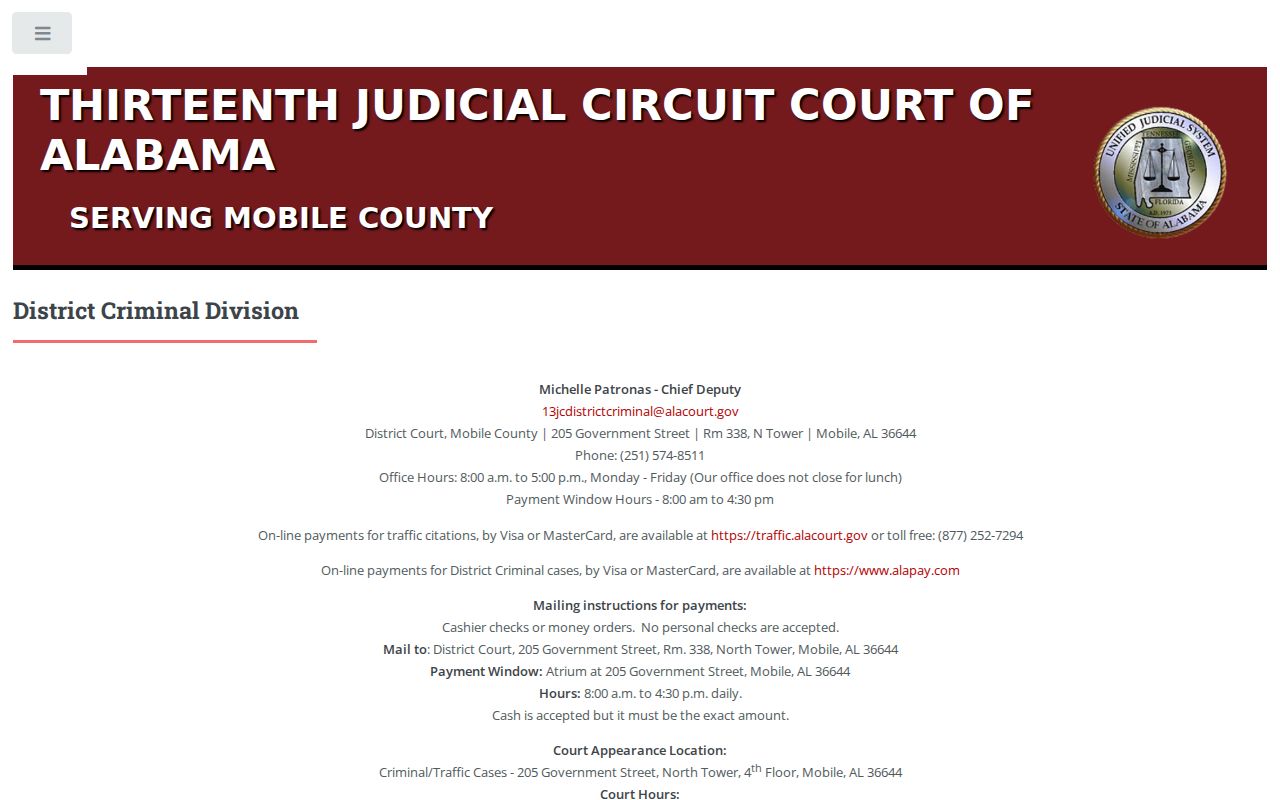
This separate counter explains why a DC misdemeanor or early felony record should not be requested from Circuit Criminal merely because both divisions serve the same county.
Mobile County Criminal Payment Entries
Financial data can appear after disposition, but a payment screen is not a substitute for the full Mobile County criminal docket. Circuit Criminal accepts cash, cashier's check, money order, Visa, Mastercard, or Discover at its payment window and does not accept personal checks. Eligible state criminal fines may be paid through AlaPay. Before paying, match the case number, court, amount type, and disposition to the court record.
The official AlaPay portal is one payment channel captured for the manifest.
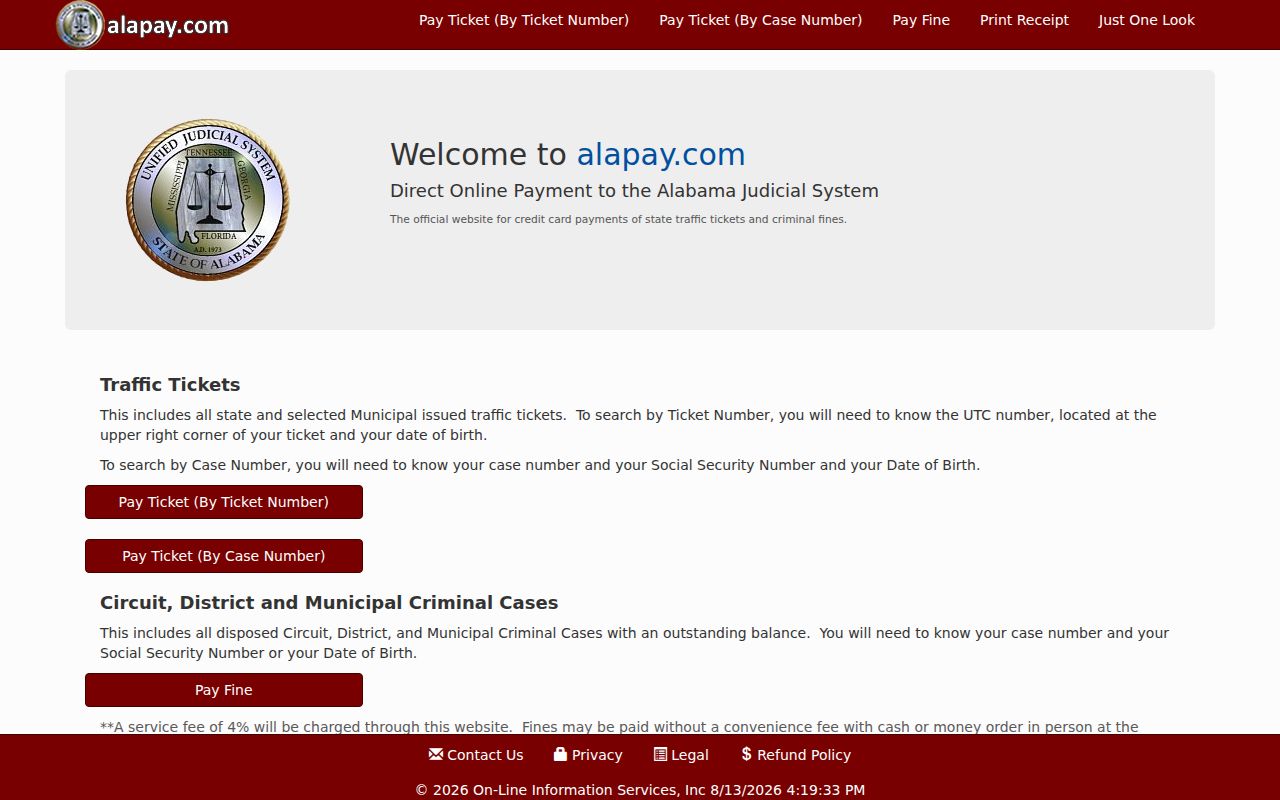
The payment result records a transaction. It does not replace the charge history, orders, sentencing entry, or clerk-authenticated copy in the Mobile County criminal case file.
Mobile County Criminal Image Restrictions
If case details appear but an image does not, contact the criminal division that owns the file. Ask whether the document is unavailable remotely, confidential, sealed, or obtainable by request.
The clerk may require ID, party status, authorization, or a court order. A missing image does not show that the underlying docket event vanished.
Public Access and Sealed Criminal Dockets
Alabama court rules govern Mobile County criminal docket access. Public Circuit and District electronic dockets and filed records may be viewed without charge at the clerk's office during regular hours under the statewide privacy rules. Remote public access uses Just One Look or Alacourt.com and may require payment. Copies can carry charges under Rule 16. Juvenile, youthful-offender, adoption, mental-health, protective, grand-jury, and court-sealed material may be restricted in whole or in part.
Key rules:
Alabama Court-Record Privacy and Confidentiality Rules govern public viewing, sealing, and restricted information.
Alabama Rule of Judicial Administration 30 governs access and bulk distribution of court records.
Alabama Rule of Judicial Administration 16 supplies the court-record copy-fee structure.
A missing public result does not prove there is no Mobile County case. Call Circuit Criminal at 251-574-8430 or District Criminal at 251-574-8511 and ask what case number, proof of identity, party status, authorization, or order is needed for the requested record.
Mobile County Criminal Setting Checks
District Criminal lists state traffic appearances at 8:00 a.m. and criminal appearances at 8:30 a.m. on the fourth floor of Government Plaza's North Tower. Circuit Criminal courtrooms are on other floors, so the case division matters before arrival. The Circuit home page also states that cell phones have been prohibited in the courthouse since June 10, 2024, with a documented summons-based exception for jurors. Allow time for the security check and elevators.
Use the newest written notice first. Then check the latest docket event and call the division. A reset means the date moved; it does not erase the old event. Circuit Criminal can be reached at 251-574-8430, and District Criminal at 251-574-8511. Court staff can confirm logistics and record procedure, though they cannot give legal advice.